In Search of Sri Chaitanya’s Birthplace
Neal Sen Sharma
Kolkata
Sri Chaitanya Mahaprabhu’s True Birthplace: Sri Dham Nabadwip or Mayapur?
O revered readers devoted to the lotus feet of Sri Gauracharan,
Whether the Supreme Lord of the theists and the great revolutionary of the atheists—Sri Gaurasundar—manifested His divine appearance within Nabadwip, which lies in Nadia district, or in Mayapur, has become a profound historical question. Yet, prior to the latter half of the eighteenth century, no such controversy existed. Nabadwip was universally recognized by all Gaudiya Vaishnavas as the sacred birthplace of Sri Chaitanya Mahaprabhu.
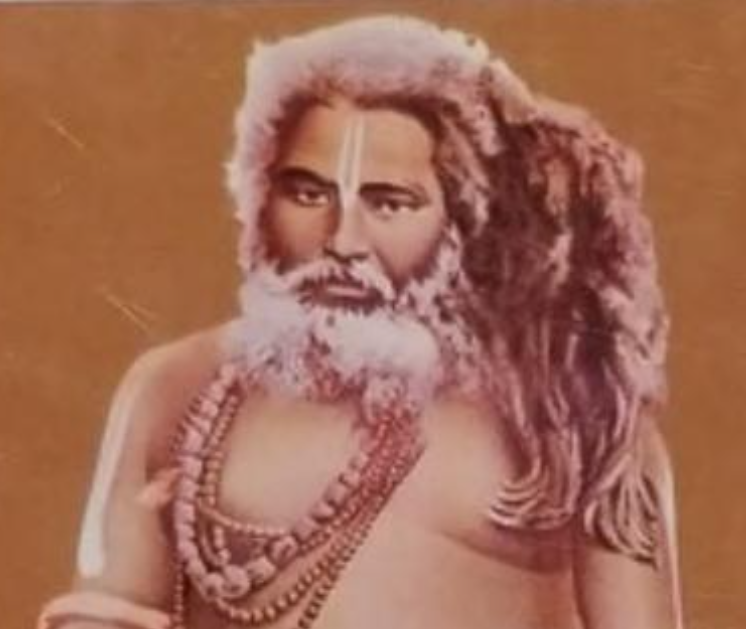
The dispute arose only when Kedarnath Dutta, Deputy Magistrate under the British Government and later renowned as Bhaktivinod Thakur, refused to accept the present town of Nabadwip as the birthplace of Sri Gauranga. In support of his stance, he cited the Vaishnava scripture Bhaktiratnakara, composed in the first half of the eighteenth century, which refers to ancient Nabadwip—or the site of Sri Gauranga’s appearance—as “Mayapur,” situated on the eastern bank of the Ganges. He therefore identified it with the Muslim-inhabited locality then known as Miyapur or Meyapur, lying within the Bamanpukur mouza adjacent to Ballal Dighi. In doing so, Bhaktivinod Thakur endeavored to conflate the “Mayapur” mentioned in Bhaktiratnakara with this particular Muslim quarter called Miyapur.
This position was vehemently opposed by the residents of Nabadwip Dham and by his own revered guru, Sri Vipin Bihari Goswami, who ultimately excommunicated him from the line of discipleship.
In the following ten points, we shall examine, both logically and historically, how far Bhaktivinod Thakur’s claim—that the so-called Mayapur is Mahaprabhu’s birthplace—is supported by evidence, and how markedly it differs from the “Mayapur” described within the sacred texts as lying inside Nabadwip.
1. If Mayapur were indeed Mahaprabhu’s birthplace, why did the great Vaishnava saints who preceded Kedarnath Dutta (alias Bhaktivinod Thakur)—the foremost among them being Vaishnava Sarvabhauma Totaram Das Babaji and Maharaja Bhagyachandra of Manipur—invariably come to the present Nabadwip and establish grand akhras and the principal temple of Sri Chaitanya Mahaprabhu there? Why was no such initiative ever undertaken in Mayapur, if it were truly the Lord’s birthplace?
2. The wooden Deity of Sri Chaitanya Mahaprabhu, personally served by His divine consort Vishnupriya Devi, is mentioned even in the earliest biography, Murari Gupta’s Kadcha:
prakāśa rūpeṇa nija priyāyāḥ svarūpa māsāḍhya nijām hi mūrtim vidhāya tasya sthita eva kṛṣṇaḥ sā lakṣmī rūpā niṣevate prabhum
Translation
In the form of light, the beloved’s true form was manifested; placing her image in the month of Māsaḍha, Krishna remained there, and Lakshmi, in the form of the goddess, serves the Lord.
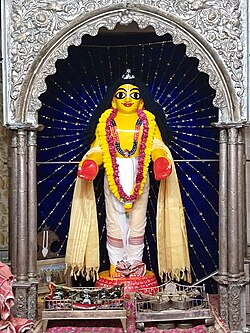
This same Deity, along with the wooden sandals (paduka) gifted by Mahaprabhu to Vishnupriya Devi, continues to be worshipped with undiminished glory in the Sri Mandira of Sri Dhameshwar Mahaprabhu in present-day Nabadwip. Notably, the original westward-facing temple, standing adjacent to the current Mahaprabhu temple, was constructed by Totaram Das Babaji long before the Mayapur controversy arose, and it still stands today. Why did no comparable institution or worship ever develop in Mayapur?
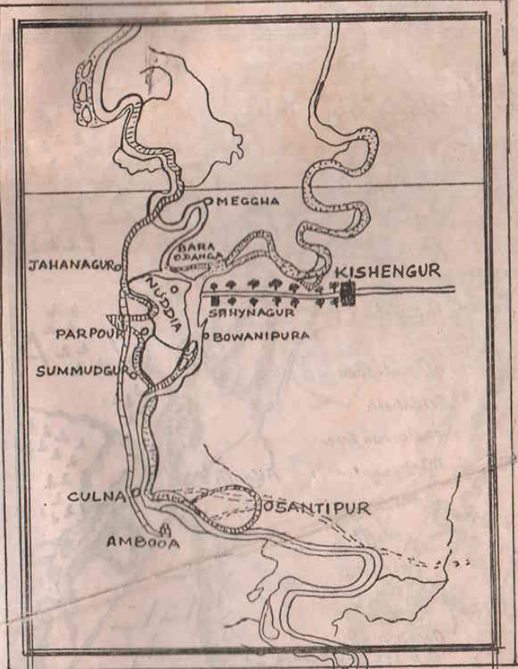
3. We now come to the change in the course of the Ganges, which lies at the very root of this controversy. The biographies of Sri Chaitanya clearly indicate that during Mahaprabhu’s time, Nabadwip lay on the eastern bank of the Ganges, whereas present-day Nabadwip stands on the western bank. This apparent contradiction is resolved by the well-documented shift in the river’s course.
That the Ganges once flowed along the western side of Nabadwip is proven beyond doubt by the following fact: if the present Nabadwip had not lain on the western bank of the Ganges in earlier times, it could never have been part of the Zamindari of the Rajas of Krishnanagar. Instead, it would have belonged to the Bardhaman Zamindari, because the ancient westward-flowing Ganges served as the natural boundary between Nadia and Bardhaman districts. This ancient western channel of the Ganges is known as the Bhagirathi Khaad. In the *Annadamangal Kavya*, poet Bharat Chandra, while describing the boundaries of Maharaja Krishnachandra’s kingdom, explicitly states:
“rājyer uttarasīmā murśidābād paścime sīmā gaṅgā bhāgīrathī khād”
Translation
Beyond the northern boundary of the king’s territory is Murshidabad, and to the west is the Ganges River.
4. It is recorded that the devout Diwan Ganga Govind Singh, descendant of the Kandi royal family and Diwan to Warren Hastings, constructed a magnificent black-stone temple at Mahaprabhu’s birthplace and resolved to install Sri Dhameshwar there. When the then servitors of Sri Dhameshwar refused consent, he instead established four Deities with their temples at that very site: Sri Gopinath, Sri Govinda, Sri Krishna Chandra, and Sri Madan Mohan Jiu. Evidence of this is found in:
Kandi o Paikpara Rajbansher Itihas, pages 19 and 29; and Territorial Aristocracy of Bengal, Chapter VI, pages 6–7, which states, while recounting the history of the Kandi Raj family:
“Ganga Govind Singh built temples at Ramchandrapore (now Nabadwip town’s Prachin Mayapur ward) at the exact spot near Nadia where Gauranga (Chaitanya) is said to have been born, for the worship of Sri Govinda, Gopinath, Krishna ji, and Madanmohan ji on the first Agrahayana 119 B.S.”
5. Further confirmation of Ganga Govind Singh’s temple—erected long before the Mayapur controversy—appears in the *Calcutta Review* of 1846 (published 1849), page 423:
“Ganga Govind Singh erected a temple over 60 ft high, which was washed away by the river 25 years ago. It was at Ramchandrapore and supplied food to many Fakirs and Vaishnavas pilgrims.”
6. The Shakta Ras Festival of Nabadwip
The Shakta Ras festival of Nabadwip was instituted at some point between 1740 and 1756. From the era of Sri Chaitanya Mahaprabhu onward, the ascendancy of Vaishnava dharma in Nabadwip steadily grew, while the royal patronage of Shakta practices gradually waned. It must be remembered that Nabadwip had long been a premier centre of Tantric sadhana. In this altered religious landscape, the adherents of Shakta doctrine sought the protection of Raja Krishnachandra of Nadia. Acting on the counsel of the Tantric adept Bhrigu, Krishnachandra directed the priests to conduct worship of the Shakta deities within their own residences on the day of Ras Purnima.
The pivotal question now arises: why, under the explicit orders of Maharaja Krishnachandra, did the Shakta Ras festival commence specifically in Nabadwip Dham? Had Sri Chaitanya’s birthplace truly been in Mayapur, logic would dictate that the festival should have originated there. Did Maharaja Krishnachandra, then, labour under a mistaken understanding of Sri Chaitanya’s janmasthana as Nabadwip?
Incidentally, the present locality of Ramchandrapur is today celebrated as the ancient Mayapur quarter within the modern town of Nabadwip. Contemporary records also attest to the renovation of the temple erected by Ganga Gobinda Singh directly over Sri Chaitanya’s birthplace, as reported in the weekly newspaper Samachar Darpan of 1820.
In this very connection, the distinguished historian Sir Jadunath Sarkar observed, in a letter published on 4 February 1932:
“dated 4th February, 1932
185, Mohanlal
Street ,
Calcutta,
4th, February 1932
“From a study of the pamphlets issued by Babu Brajmohan Das on the actual position of that quarter of Nabadwip in which the Saint Chaitanya was born it seems to be a strong case, for giving finality to the settlement of the question by locating the now-fallen temple of Dewan Ganga Govind Singh. The excavation of this site where this temple is said to lie buried, is a work of the deepest concern to Bengali Vaishnavas, and in view of the antiquity and importance of the building. I feel that the Archaeological Department would be justified in declaring it a protected monument and permitting its excavation under its supervision, if private funds are forthcoming for the purpose.”
7. In the pada composed by Udbhav Das—a contemporary lyricist of Mahaprabhu—concerning the Kazi Dalan Lila, clear evidence emerges that Mahaprabhu’s birthplace lay at no great distance from the residence of Vishnupriya Devi. It was situated somewhere in the heart of Ramchandrapur, in the northwest of present-day Nabadwip. This same proximity is subtly indicated in the Kazi Dalan Lila section of the Chaitanya Bhagavata. Vishnupriya Devi’s birthplace remains perfectly preserved to this day in Malancha Para of Nabadwip. Gauranga’s own house is understood to have stood perhaps half a mile away (vide Udbhav Das’s pada).
The relevant verses run as follows:
“On the day Gaurahari subdued the Kazi
And traversed the length of Nabadwip,
Crossing the four ghats, passing through Ganganagar village,
Thereafter to the exquisitely adorned reservoir.
At that very reservoir Chand Kazi made his abode;
Shimulia is the name of that hallowed place.
Having subdued the Kazi, Gaurahari with his devotees
Proceeded in the southern direction.
Intoxicated with sankirtana, conch and tanpura sounding,
The two wandered in sublime ecstasy.
From Shridhar’s house, through Gadigacha and Majida,
Westward to the locality of Paradanga.
North of that, passing the house of the Raja Pandit,
He gladdened the throng of devotees with boundless joy.
A short distance to the northwest, upon the southern bank of the Ganges,
Gaurahari returned to his own dwelling.
To the north lies his personal ghat; eastward of it, Madhai’s ghat;
Hard by stands Shrivasa’s courtyard.
In its northeastern corner is the ghat called Barakona,
Which is none other than Shuklambar’s ashram.
A little further north rises the Nagariya ghat precinct;
North of that lies Ganganagar village.”
This song of the town procession was composed
By this humble-minded Udbhav, to purify his own understanding.”
8. Mahaprabhu’s marriage to Vishnupriya Devi. Should the so-called Mayapur championed by the Mayapur advocates indeed be accepted as Mahaprabhu’s birthplace or residence, a further irreconcilable historical contradiction immediately surfaces—this time concerning the account of Mahaprabhu’s marriage to Vishnupriya Devi as recorded in the authentic Chaitanya Charitas, notably the Chaitanya Bhagavata. There we find that when Mahaprabhu proceeded to marry Vishnupriya Devi, he was not required to cross the Ganges at all—indicating that the two households stood within the same neighbourhood. Vishnupriya Devi’s birthplace remains intact in Malancha Para of Nabadwip. Were the present Mayapur to be taken as the birthplace, Mahaprabhu would necessarily have had to cross the river for the marriage ceremony—an assertion wholly at variance with the Chaitanya Bhagavata’s description. If we designate Vishnupriya Devi’s birthplace as Point A, then in its Vayu Kona (northwest) at Point B stood Gauranga’s house—an alignment explicitly corroborated by Udbhav Das’s pada.
9. The Chaitanya Bhagavata contains vivid descriptions of numerous localities of contemporary Nabadwip, several of which—such as Gadigacha, Paradanga, and Majida—still exist under the same names today. Vrindavan Das Thakur has delineated these areas with unmistakable clarity. Yet why is there not a single mention of the Mayapur that ISKCON and the Gaudiya Math insist was the Lord’s birthplace? It strains credulity to suppose that so meticulous and divinely inspired an author as Vrindavan Das Thakur would have omitted so crucial a detail. Nor is the Chaitanya Bhagavata alone in this silence. In no authentic Chaitanya Charita—not even in the Oriya texts—is there the slightest trace or even a whisper of Mayapur as Mahaprabhu’s janmasthana.
10 Bhakti Ratnakara. As for the Mayapur described in the eighteenth-century Bhakti Ratnakara, it bears no relation whatsoever to the present-day Mayapur (or Miyanpur). The site currently designated “Mayapur,” lying south of Ballal Dighi, was during Mahaprabhu’s time essentially a Shudra settlement and could never have served as the birthplace of the Lord, who took birth in an exalted Brahmin lineage. The Mayapur of the Bhakti Ratnakara is merely an alternative name for Mahaprabhu’s own residence within present Nabadwip—not a separate locality. The author himself makes this explicit:
“Within Nabadwip lies a place called Mayapur, Where the divine Gaurachandra accepted His abode in exact accordance with truth.”
Thus the “Mayapur” of the Bhakti Ratnakara is situated squarely inside Nabadwip itself and cannot be conflated with the modern site.
References: Kandi O Paikpara Rajbansher Itihas, pp. 19 & 29; and Territorial Aristocracy of Bengal, Chapter VI, pp. 6–7, in its account of the Kandi Raj family: “Ganga Govind Singh built temples at Ramchandrapore (now the ancient Mayapur area of Nabadwip town) at the exact spot near Nadia where Gauranga (Chaitanya) is said to have been born, for the worship of Sri Gobinda, Gopinath, Krishna ji and Madan Mohan ji on the first Agrahayana 119 B.S.”
About the Author